
Best AI Petition Preparation Tools for Bankruptcy Attorneys (2026)
Your petition prep workflow hasn't changed in years. Paralegals pull credit reports, manually enter data into forms, calculate means tests by hand, and spend 3 to 5 hours per case on work that AI bankruptcy filing software can complete in minutes. The challenge is separating tools that actually analyze documents and run autonomous workflows from legacy systems that just moved your paper forms to a screen. We reviewed six options based on whether they replace the manual work or just reorganize it.
TLDR:
- AI petition prep tools auto-populate bankruptcy schedules from credit reports and documents
- Glade AI automates intake through filing with embedded AI agents that handle follow-ups autonomously
- Legacy tools like Best Case require manual data entry; Glade's AI extracts and populates forms
- Native payment processing in Glade eliminates 60-90 day collection cycles from external billing
- Firms save 3-5 hours per case by shifting paralegals from data entry to client service work
What is AI Petition Preparation Software for Bankruptcy Attorneys?
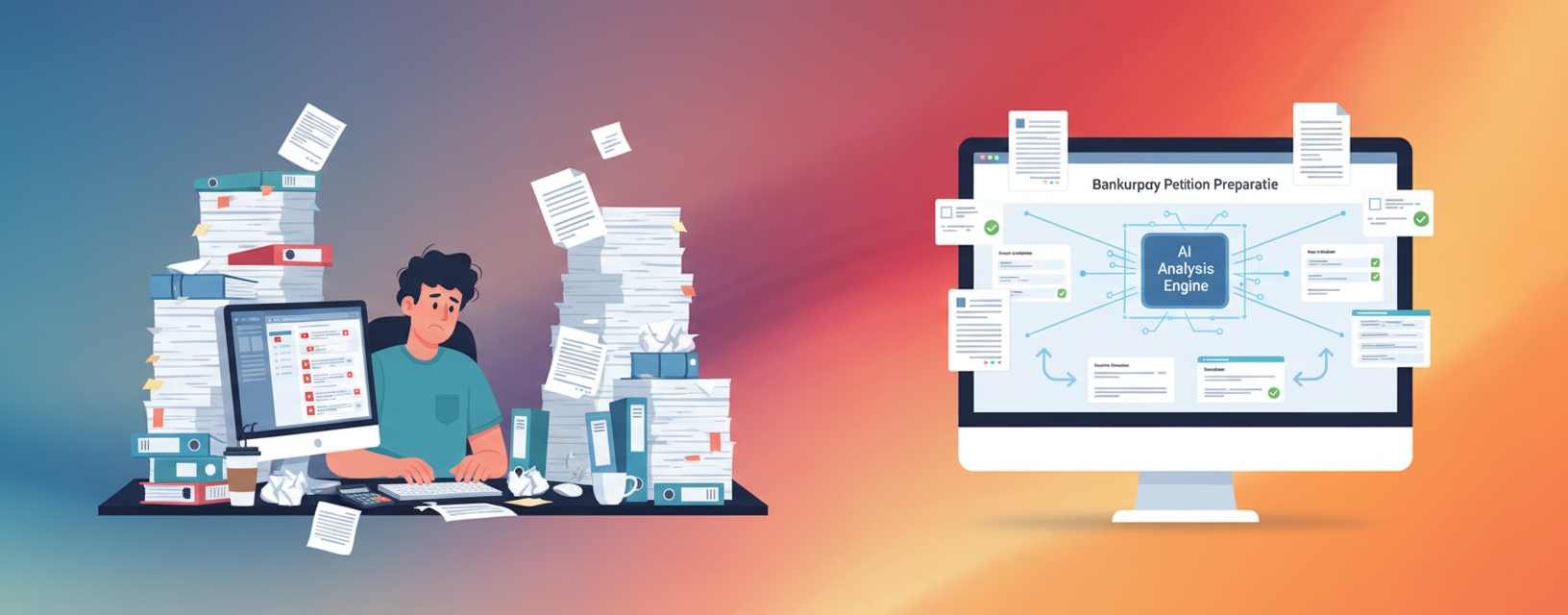
AI petition preparation software uses AI agents to automate the data entry that typically consumes hours of paralegal time per bankruptcy case. These tools read financial documents, extract information from credit reports, auto-populate bankruptcy schedules, and calculate means tests without manual input.
The difference from traditional bankruptcy software comes down to who does the work. Legacy systems require paralegals to manually input every data point. AI petition preparation software reads documents, identifies relevant information, and populates forms automatically. A paralegal reviews the output instead of creating it from scratch.
This shift saves 3-5 hours per case and reduces transcription errors that can delay filings.
How We Ranked These Tools
We reviewed these tools based on what bankruptcy attorneys need to scale case volume without hiring more staff.
The ranking criteria include:
- AI integration depth: Does the AI actually analyze documents and run workflows, or just auto-fill fields you could do yourself?
- Workflow coverage: Does the tool handle intake through filing, or just one piece of the process?
- Native payment processing: Can you collect retainers and manage payment plans inside the system?
- Bankruptcy-specific features: Credit report integration, means test automation, schedule population
- Client portal functionality: Can clients submit documents and track their case status?
- Implementation time: How long before your team is productive?
These criteria reflect the real bottlenecks in bankruptcy practices. Tools that automate data entry but still require manual follow-ups and separate billing systems don't solve the scaling problem.

Best Overall AI Petition Preparation Tool: Glade AI
Glade AI is an AI operating system for bankruptcy law firms that prepares PACER petitions by parsing credit reports and financial data, then generating court-ready PDFs. Unlike legacy petition prep tools that rely on basic auto-fill, Glade deploys specialized AI agents for mortgage analysis, income extraction from pay stubs, and means test calculations.
Data collected in earlier workflow steps automatically pre-populates petition schedules. AI agents embedded in workflows handle intake, document collection, payment plans, invoicing, and post-filing workflows autonomously. Native Stripe and Confido payment integration eliminates external billing systems. White-labeled client portals allow clients to upload documents, complete forms, and make payments without paralegal intervention.
Glade AI is the best choice for bankruptcy firms that want to scale case volume without scaling headcount.
Filevine
Filevine offers a legal work system that handles document management, client communication, and business analytics across multiple practice areas. Over 25,000 legal professionals use it daily, primarily in personal injury and immigration law.
Filevine's case management includes AI-powered document organization, deadline tracking, and client communication tools. The system includes ImmigrationAI capabilities and contract review features designed for complex litigation workflows.
This works well for large personal injury or immigration firms with complex case management needs who can dedicate months to implementation and custom configuration. However, Filevine treats bankruptcy as an add-on, not a core practice area. The system lacks bankruptcy-specific automation like credit report pulls, means test calculations, or petition-focused AI agents. Implementation takes months and requires customization to adapt personal injury workflows for bankruptcy practices.
Clio
Clio is a general practice management system used by over 150,000 legal professionals across multiple practice areas. It handles client intake, billing, document management, and client communication for firms that need broad functionality over practice-specific automation.
Clio works well for general practice firms managing multiple case types that need reliable, stable case management with wide feature coverage. Firms that handle family law, estate planning, and business law in the same system will find Clio's flexibility useful.
The limitation for bankruptcy practices is that Clio doesn't understand bankruptcy workflows. It lacks native credit report integration, automated means test calculation, and bankruptcy schedule population. Clio Duo is a generic legal assistant, not trained on petition analysis or the specific data extraction bankruptcy cases require.
Best Case
Best Case by Stretto offers a web-based bankruptcy filing system with forms for Chapter 7, 11, and 13 cases, including 10 gigabytes of data storage. The software provides OneTouch e-filing integration with bankruptcy courts, task management and document storage, a client portal for basic case access, and automated compliance updates when bankruptcy rules change.
Best Case works for firms deeply invested in the existing ecosystem who primarily need reliable filing capabilities and court integrations. The limitation is that Best Case runs on legacy infrastructure with slow development cycles under Stretto's corporate ownership. The system lacks AI document analysis, workflow automation for intake and follow-ups, or built-in payment processing. You'll pay per-filing fees on top of annual subscription costs. Your team still handles most case administration manually.
Jubilee Pro
Jubilee Pro handles Chapters 7, 11, 12, and 13 bankruptcy cases through a cloud-based petition preparation system accessible from any device with internet access.
The software offers multiple pricing tiers, including Jubilee 36 with 36 annual filings and a Chapter 7 plan with unlimited filings for three users. Core features include cloud-based petition preparation starting at $50 per month, basic case tracking, document templates, and integration with select legal software.
Jubilee works for solo practitioners filing fewer than 10 cases monthly who need basic petition prep at the lowest price point. The limitation is that Jubilee is a petition tool only. It has no client portal, no workflow automation, no AI document analysis, and no native payment processing. The system lacks AI capabilities entirely and isn't built for firms processing 50+ cases monthly who need scalability.
Growing firms need workflow automation, AI agents, and client self-service tools that Jubilee doesn't provide.
NextChapter
NextChapter is a cloud-based bankruptcy case management system for Chapter 7, 11, and 13 filings with CM/ECF e-filing, means testing, and document automation. Over 1,000 bankruptcy attorneys use the software.
The system includes MyChapter client portal for document collection and case updates, NextMessage text communication with unique local phone numbers, and AI-powered form validation and workflow triggers. Pricing starts at $159 annually for up to four cases and six concurrent users.
NextChapter works for bankruptcy-focused firms that want filing-centric software with basic client communication but requires external payment integrations like LawPay for billing. The AI handles form validation instead of document analysis or petition auto-population.
Feature Comparison Table of AI Petition Preparation Tools
The table below compares core features across the six tools covered in this guide.
Feature | Glade AI | Filevine | Clio | Best Case | Jubilee Pro | NextChapter |
|---|---|---|---|---|---|---|
AI Document Analysis | Yes | No | No | No | No | No |
AI Petition Auto-Population | Yes | No | No | No | No | No |
Native Credit Report Integration | Yes | No | No | No | No | No |
Automated Means Test Calculation | Yes | No | No | Yes | Yes | Yes |
Client Portal with Payments | Yes | No | Yes | No | No | No |
Native Payment Processing | Yes | No | Yes | No | No | No |
Bankruptcy-Specific AI Agents | Yes | No | No | No | No | No |
Automated Client Follow-ups | Yes | No | No | No | No | Yes |
E-Filing Integration | Yes | Yes | Yes | Yes | Yes | Yes |
Workflow Automation | Yes | Yes | No | No | No | Yes |
Glade AI is the only tool that combines AI document analysis with bankruptcy-specific automation and native payments in a single system.
Why Glade AI is the Best AI Petition Preparation Tool for Bankruptcy Attorneys
Glade AI is the only tool built to run bankruptcy firms autonomously instead of only preparing filings. Other options require your team to manage the system. Glade's AI agents manage the work while your team handles decisions.
The difference shows up in how firms scale. Competitors add filing capabilities to existing workflows. Glade replaces the workflow itself. When a client submits an intake form, AI agents pull credit reports, request missing documents, follow up on incomplete submissions, calculate means tests, populate petition schedules, generate invoices, and process payments without paralegal intervention.
This changes the economics of running a bankruptcy practice. Paralegals spend their day on client service and exception handling instead of data entry and follow-ups.
Final Thoughts on AI Tools for Bankruptcy Petition Prep
Bankruptcy petition automation works when it removes tasks from your team's plate, not when it just makes those tasks easier to track. The firms that scale without hiring do it by replacing manual work with AI agents that handle document analysis and data population autonomously. Your choice depends on whether you want software that assists your workflow or runs it for you.
FAQ
How do I choose the right bankruptcy petition software for my firm?
Start by reviewing your case volume and staffing constraints. If you're processing 50+ cases monthly and your paralegals spend most of their day on follow-ups and data entry, you need AI-powered workflow automation beyond basic petition prep. Look for tools that handle document analysis, client communications, and payment processing in one system instead of adding another disconnected tool to your stack.
Which petition preparation tool works best for solo practitioners versus mid-size firms?
Solo practitioners filing fewer than 10 cases monthly may find basic petition prep tools like Jubilee Pro adequate for their needs. Mid-size firms processing 50+ cases monthly need AI agents that run intake, document collection, and client follow-ups autonomously. The difference is whether you need a filing tool or a system that scales case volume without scaling headcount.
Can AI petition software actually reduce the time my paralegals spend on each case?
Yes, but only if the AI analyzes documents and runs workflows autonomously. Software that just auto-fills forms you could populate yourself saves minimal time. AI that reads credit reports, extracts data from pay stubs, calculates means tests, and follows up with clients automatically saves 3-5 hours per case by turning your paralegal's role from data entry to exception handling.
What's the difference between AI document analysis and basic auto-fill features?
Basic auto-fill moves data you've already entered into petition forms. AI document analysis reads financial documents, identifies relevant information, and populates bankruptcy schedules without manual input. One requires your paralegal to type everything first, the other reads the documents directly and your paralegal reviews the output instead of creating it from scratch.
Do I need native payment processing in my bankruptcy software?
Native payment processing changes billing from a separate back-office task into an automated workflow step. Retainers get collected at intake, payment plans set up automatically with engagement letters, and reminders go out without manual tracking. Firms using external billing systems typically have 60-90 day collection cycles, while built-in payments speed up revenue realization and reduce accounts receivable.